Manipur High Court halted Census 2027 house-listing until October 12 after Centre and state agreed to defer enumeration, following petitions citing illegal immigration data and IDP displacement risks.
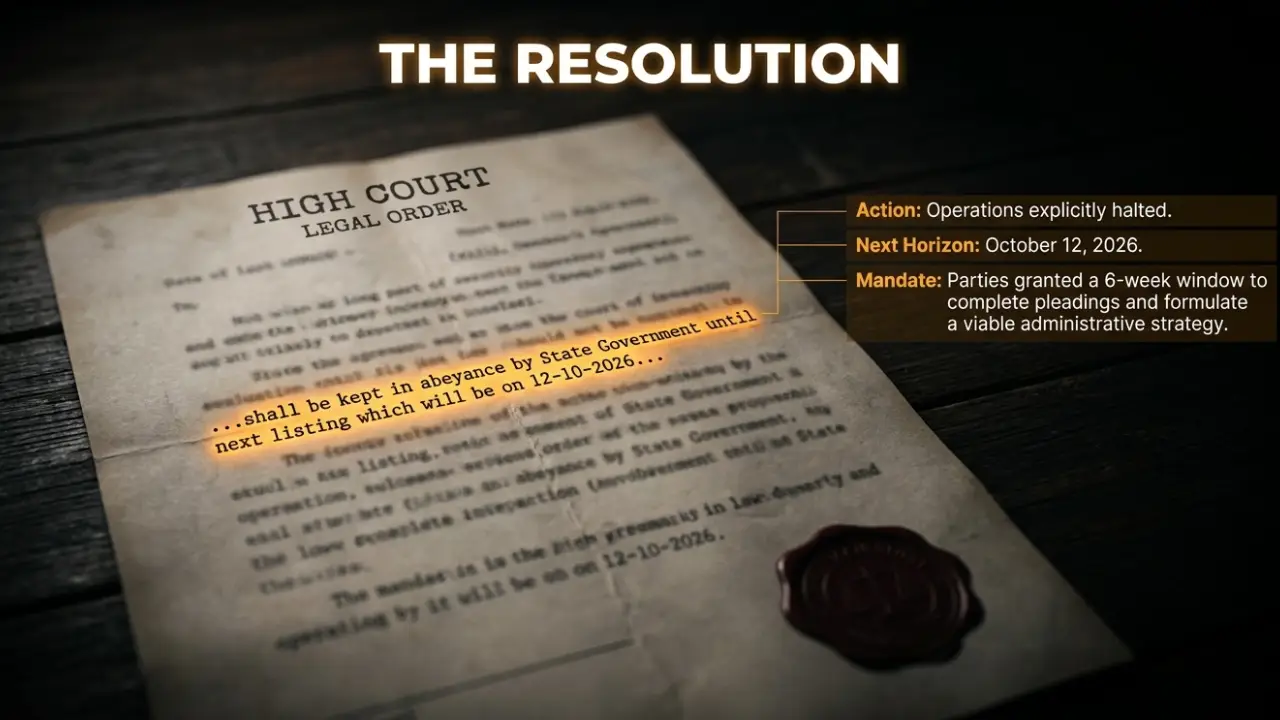
Imphal, August 31: The High Court of Manipur has ordered that house-listing operations for the Census of India, 2027, be kept in abeyance across the state until October 12, 2026 — a day before enumeration was scheduled to begin.
A Special Division Bench comprising Chief Justice M. Sundar and Justice A. Guneshwar Sharma passed the order on Monday, less than 24 hours before house-to-house enumeration was due to start on September 1. The bench acted after the Central Government and the Government of Manipur submitted formal undertakings stating that an executive decision had already been taken to postpone the exercise in the state.
The order follows weeks of legal proceedings triggered by petitions from student bodies, civil society groups and individual citizens, who argued that carrying out a census amid ongoing ethnic violence, large-scale displacement and unresolved concerns over illegal immigration could distort population data used for political representation and resource allocation.
Two petitions, one bench
The case before the court combined two separate proceedings. The first, Public Interest Litigation (PIL) No. 14 of 2026 along with Miscellaneous Case No. 16 of 2026, was filed jointly by the Kangleipak Students' Association (KSA), represented by its secretary Huirongbam Babulu Singh, and the International Peace and Social Advancement (IPSA), represented by its president Maibam Bisheshwor.
RELATED NEWS: Centre Defers Census in Manipur After Amit Shah Chairs High-Level Review Meeting
The second, Writ Petition (Civil) No. 623 of 2026 along with Miscellaneous Case No. 649 of 2026, was filed by Shanta Singh Nahakpam, a resident of Imphal West district now residing in Imphal East. That petition had originally been placed before Justice Guneshwar Sharma as a single bench, which referred it to the Chief Justice on August 24 for consolidation with the PIL, citing overlapping issues. Counsel for both sides agreed to the tagging on August 25, with the bench noting it was "convinced about the overlap and the common issues."
RELATED NEWS: 14 CSOs Welcome HC Ruling On Census Deferment, Warn Politicians Against Using NRC for Votes
The Central Government was represented by Deputy Solicitor General of India Kh. Samarjit, appearing for the Union Home Ministry, the Registrar General and Census Commissioner of India, and the Director of Census Operations for Manipur. The state government was represented by Advocate General Lenin Hijam. The PIL petitioners were represented by senior advocate Kh. Tarunkumar, and the writ petitioner by advocate Hijam Chandrakumar Singh.
The notifications under challenge
Two executive notifications were at the center of the dispute. The first, issued by the Registrar General and Census Commissioner of India on January 7, 2026, set the national schedule for the 2027 census under the Census Act, 1948, and the Census Rules, 1990. The second, issued by the Commissioner (Home), Government of Manipur, on March 22, 2026, fixed September 1, 2026, as the start date for house-listing operations in the state.
Petitioners sought to halt both notifications, arguing that enumeration should not proceed without first updating the National Register of Citizens (NRC) and establishing safeguards for people displaced by the ethnic conflict that has gripped Manipur since May 2023.
Petitioners cite unanimous assembly resolutions on NRC
Arguing for the PIL petitioners, senior advocate Kh. Tarunkumar relied on internal Manipur Home Department correspondence sent to the Union Home Secretary, including letters dated January 16, 2023, and June 12, 2024. According to the documents, the Manipur Legislative Assembly had twice unanimously resolved to introduce the NRC in the state, first in a resolution passed on August 5, 2022, and again after the outbreak of ethnic violence in 2023.
The state government's January 2023 letter quoted the assembly resolution directly:
"The House of the Manipur Legislative assembly unanimously resolves to establish the Population Commission of the State and also to introduce and enforce National Register of Citizens."
The 2024 letter reaffirmed the position, stating that the assembly wished to "urge the Government of India to implement National Register of Citizens (NRC) in Manipur in the interest of the State in particular and of the Nation in general."
The Home Department's correspondence also explained the reasoning behind the resolutions, according to the documents cited in court:
"The resolution taken by the Manipur Legislative Assembly is the manifestation of growing fear and apprehension of the people of Manipur that many foreign nationals of Myanmar and Bangladesh origin might have immigrated illegally and settled in the State by forging documents."
The letter went on to state that the presence of such immigrants "may cause demographic imbalance and threat to national security and sovereignty of the country," and that they "can only be detected through dedicated and rigorous checking of ancestral records which is only possible through introduction and enforcement of NRC in the State."
Data table: decadal population growth by district
To support the argument that undocumented immigration had skewed population figures, the state's Home Department placed a district-wise population table before the court, drawn from official records spanning the 1991, 2001 and 2011 census cycles.
|
District |
1991 Pop. |
Decadal Growth (%) |
2001 Pop. |
Decadal Growth (%) |
2011 Pop. |
Decadal Growth (%) |
|
Imphal West |
7,11,261 |
27.64% |
4,44,382 |
15.42% |
5,17,992 |
16.56% |
|
Imphal East |
— |
— |
3,94,876 |
19.16% |
4,56,113 |
15.51% |
|
Thoubal |
2,93,958 |
26.34% |
3,64,140 |
24.62% |
4,22,168 |
15.94% |
|
Bishnupur |
1,80,773 |
27.52% |
2,08,368 |
13.90% |
2,37,399 |
13.93% |
|
Senapati |
2,08,406 |
36.13% |
1,56,513* *(excl. 3 sub-div) |
81.96% |
4,79,148 |
68.94% |
|
Churachandpur |
1,76,184 |
31.00% |
2,27,905 |
29.81% |
2,74,143 |
20.29% |
|
Ukhrul |
1,09,275 |
31.74% |
1,40,778 |
28.98% |
1,83,998 |
30.70% |
|
Chandel |
71,014 |
25.81% |
1,18,327 |
72.80% |
1,44,182 |
21.85% |
|
Tamenglong |
86,278 |
38.51% |
1,11,499 |
29.23% |
1,40,651 |
26.15% |
*2001 figure for Senapati excludes three sub-divisions. (Source: Manipur Home Department communication No. H-3401/3/2022-HD-HD)
(Source: Official communication No. H-3401/3/2022-HD-HD, Home Department, Government of Manipur)
The state government's submission noted an apparent contradiction in these numbers. Valley districts such as Imphal East, Imphal West, Thoubal and Bishnupur — which typically draw internal migration due to better healthcare and livelihood opportunities — recorded comparatively modest growth. Hill districts including Senapati and Chandel, by contrast, showed decadal growth of 81.96% and 72.80% respectively between 2001 and 2011. The department's letter, quoted in the proceedings, described this as "an abnormal phenomenon which may be largely attributed to illegal immigration."
The submission also pointed to Aadhaar enrolment gaps as a possible indicator, stating that enrolment in valley districts stood at around 110% of population — consistent with Aadhaar's use as a near-universal identity document — while Senapati's enrolment was as low as 58.31%, which the department said "may be an indication of presence of large population without proper documents."
On enforcement, the Home Department cited figures showing 478 cases of Myanmar nationals pushed back by police in 2021 alone, and 208 illegal immigrants — 202 of them Myanmar nationals — apprehended between 2016 and 2022, figures the department said excluded pushback cases recorded separately by the Assam Rifles, the force guarding the border.
IDP crisis and constitutional concerns
The companion writ petition, argued for Shanta Singh Nahakpam, focused on the impact of displacement caused by the ethnic clashes that began in May 2023. In a representation dated April 13, 2026, addressed to the Registrar General and Census Commissioner of India, the petitioner argued that conducting an unadjusted headcount in an active conflict zone risked distorting democratic outcomes.
The representation listed specific risks, according to the petition:
i. Distortion of demographic data due to displacement.
ii. Skewed allocation of resources and welfare benefits.
iii. Unfair delimitation and dilution of political representation.
iv. Long-term inaccuracies in national statistical records."
The petitioner argued that proceeding without safeguards would infringe constitutional guarantees under Article 14 on equality, Article 170 on fair representation in constituencies, and Articles 19, 21 and 326 concerning democratic rights, citing the Supreme Court's 2023 ruling in Anoop Baranwal v. Union of India on the link between free elections and reliable institutions.
The petition also drew on precedent, noting that census operations were not conducted in Assam in 1981 and Jammu and Kashmir in 1991 due to instability, and that Census 2021 itself was postponed nationwide due to the COVID-19 pandemic. "These demonstrate flexibility in the decennial character of the Census when integrity of data is at stake," the representation said.
Among the specific directions sought were a requirement to record the original place of residence for displaced persons, introduction of a displacement status field in census questionnaires, special standard operating procedures for enumerators in conflict-affected areas, and either deferment or phased enumeration until stability is restored.
How the hearings unfolded
The matter moved quickly through a series of hearings in the final ten days of August. On August 21, the court directed both governments to file their explicit positions on four pending civil society representations. On August 25, the Deputy Solicitor General submitted a status report from the Office of the Registrar General showing that two representations — from IPSA and the Joint Committee Opposing Delimitation Exercise in Manipur (JCODEM) — had been marked for a decision "at the level of State," while a separate JCODEM representation seeking recounting in nine hill sub-divisions, tied to a 2007 Gauhati High Court judgment, and a memorandum from 14 civil society organisations demanding an NRC 1951 update were both listed as "under examination."
Unsatisfied that the respondents had stated their final positions, the bench adjourned the matter to August 28 on a peremptory basis. At that hearing, both the Deputy Solicitor General and the Advocate General sought a short accommodation until August 31, telling the court the issues were "being examined at the highest level" and that they were hopeful of returning with what they called a "viable answer." The Advocate General also assured the bench that, under the existing state notification, house-listing was not due to begin until September 1 — meaning no immediate harm would occur in the interim.
Monday's order
When the Special Bench reconvened on August 31, the Deputy Solicitor General told the court that the Registrar General and Census Commissioner had decided, after internal discussions, to defer house-listing operations in Manipur, and that a formal notification amending the January 2026 central notification would follow "in due course." The court recorded this submission as a formal undertaking from the Centre.
The Advocate General then confirmed that the state government would not begin house-listing on September 1 as originally scheduled, and that the state notification would be kept in abeyance pending the Centre's formal deferral order. This too was recorded as an undertaking. Both law officers told the court it would be appropriate to list the matter after four weeks, during which the issues raised by petitioners would be examined "at the highest level." Counsel for the petitioners said they were satisfied, for the present, with these recorded positions.
The bench's operative order directed that house-listing "shall be kept in abeyance by State Government until next listing," fixed for October 12, and directed both sides to complete their pleadings in the meantime. The court also ordered that the order be uploaded to the High Court's official portal, with all authorities and citizens bound by that uploaded copy.
What happens next
The order does not resolve the underlying dispute. It grants the Centre and the state roughly six weeks to work out an administrative approach to two separate but connected demands — implementing the NRC in Manipur and building in specific protections for the state's internally displaced population before any census exercise proceeds. The matter returns before the Special Bench on October 12, at which point the Centre is expected to have issued a formal notification confirming the deferral, and both governments are expected to report back on how they intend to address the petitioners' concerns.