A May 7 pre-dawn assault on Tangkhul Naga villages in Manipur’s Kamjong district, allegedly carried out by Myanmar-based KNA-B and VVEZ militants, reignited debate over cross-border terrorism, with drone strikes, arson, and abductions fueling divisions over whether it constituted foreign aggression.
A May 7 pre-dawn assault on Tangkhul Naga villages in Manipur’s Kamjong district, allegedly carried out by Myanmar-based KNA-B and VVEZ militants, reignited debate over cross-border terrorism, with drone strikes, arson, and abductions fueling divisions over whether it constituted foreign aggression.
In the early hours of May 7, 2026, a cluster of Tangkhul Naga villages perched less than a kilometre from the international boundary in Manipur's Kamjong district came under a sophisticated, coordinated assault. The villages of Namlee, Wanglee Market, and Z. Choro were targeted by pre-dawn arson, drone-based strikes, and a ground offensive carried out by a force estimated between 100 and 300 militants, who then retreated across the border into Myanmar. A civilian, 45-year-old Olina Ningshen, was abducted. At least 21 others from Wanglee Market were reported missing. The central question since has been: who was responsible?
The Village Volunteers Eastern Zone (VVEZ) was the first to step forward, issuing a public statement claiming full responsibility for the coordinated attacks. The group framed the operation as retaliatory, citing the alleged burning of Lancha Kuki village on May 2, 2026, and described its targets as the NSCN-IM's "Eastern Flank". By presenting the assault as a local ethnic response to a prior provocation, the VVEZ sought to frame the incident as an internal communal conflict.
ALSO READ: The Metastasizing Frontier: How Manipur's Unresolved Conflict Is Consuming Ukhrul and Kamjong
However, regional analysts and local observers have questioned whether the VVEZ claim is the full picture, or whether it serves as a deliberate political facade. The tactical profile of the May 7 assault, including the use of 40mm lathode guns, rocket launchers, grenade-launching systems, and drones for both aerial reconnaissance and munitions deployment, goes far beyond the capabilities ordinarily associated with a village volunteer force. The entry of the attacking column through border pillars 5 to 10, and its subsequent retreat into Myanmar, strongly suggests cross-border coordination with a more powerful and better-equipped entity.
The most authoritative identification of the perpetrators comes from the Assam Rifles. In its official communication surrounding the rescue of Olina Ningshen, secured on May 9, 2026, at approximately 3:30 PM south of Z. Choro through a joint operation with intelligence agencies, the paramilitary force specifically named the Kuki National Army-Burma (KNA-B) and the Village Volunteers Eastern Zone (VVEZ) as the militants present at the scene of her abduction during the pre-dawn attack on Namlee, though it felt short of attributing the attack to these groups.
Further evidence of KNA-B involvement emerged from a concurrent Assam Rifles operation in Churachandpur district, where the 5 Assam Rifles apprehended Lal Thag John (38), an armed cadre of the KNA-B who had allegedly infiltrated from Myanmar to "create unrest." The capture of an active KNA-B operative inside Indian territory within 24 hours of the Kamjong assault reinforces the assessment of a deliberate, organised cross-border incursion.
|
|
The KNA-B has denied involvement, calling allegations "false and malicious" — yet the Assam Rifles named both the KNA-B and VVEZ directly in connection with the civilian abduction, and an active KNA-B cadre was arrested inside Indian territory the following day. |
While the military evidence points toward KNA-B and VVEZ joint responsibility, the political framing of the attack has become sharply contested. Phungyar MLA Leishiyo Keishing and former Chief Minister N. Biren Singh characterised the raid as "external aggression" and "cross-border terrorism", language that would require a fundamentally different institutional response, potentially involving India's Ministry of External Affairs and Ministry of Defence.
ALSO READ: Between Resolve and Resignation: The Dual Legacies of May 7th
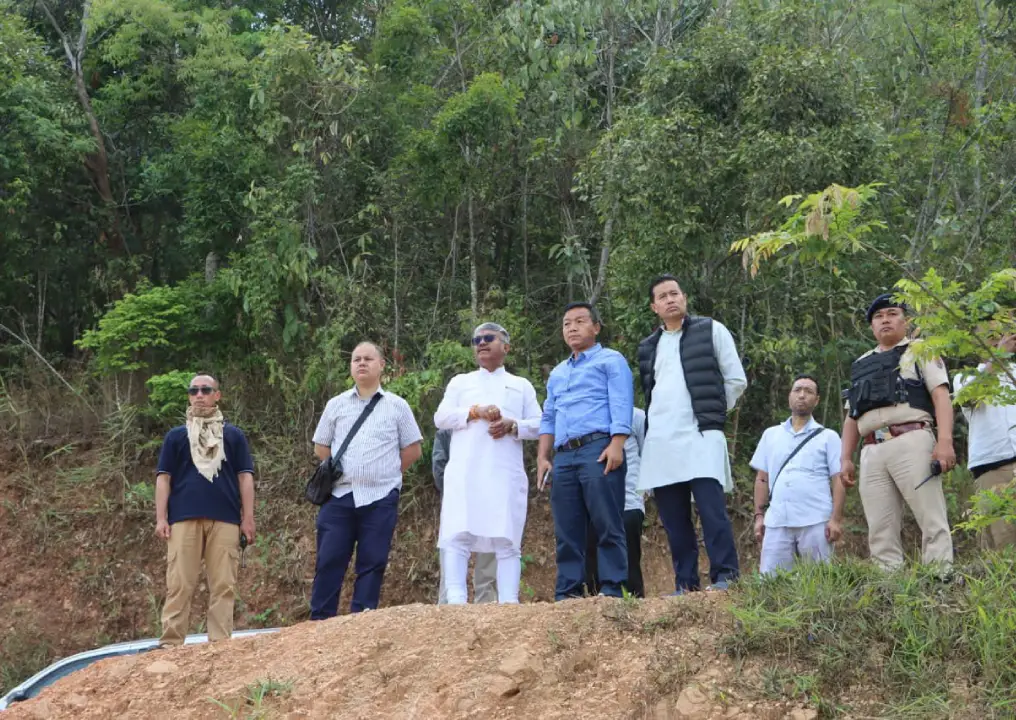
Home Minister Govindas Konthoujam, however, categorically rejected these labels following his visit to the affected villages on May 9. He stated that the term "foreign aggression" did not appear in official reports submitted to the state government by the district administration and security apparatus, a position that effectively keeps the incident within the framework of a domestic ethnic conflict, avoiding the diplomatic and military escalations that an "external aggression" designation would demand.
Instead, the Minister focused on security lapses at the border and called for an additional 7,000 state personnel to police the frontier zone, while assuring villagers that the government would evaluate replacing central forces with state security units.
Travelled across nearly 40 km along the India–Myanmar border in Kamjong District, visiting Nambashi, Namlee, Wanglee, Z. Choro, and Kaka villages along with Hon’ble MLAs Thongam Biswajit Singh, Md. Abdul Nasir, Kashim Vashum, Ram Muivah, Leishiyo Keishing, and Thangjam Arunkumar… pic.twitter.com/c9dkoCW5ni
— Govindas Konthoujam (@KonthoujamG) May 10, 2026
The weight of available evidence points to the May 7 assault being a joint hybrid operation between the KNA-B and the VVEZ. Ground reports specifically named KNA-B cadres as villagers fleeing the scene saw armed militants with KNA-B badges. The KNA-B likely contributed the tactical expertise, sophisticated weaponry, and cross-border logistics, while the VVEZ provided local intelligence and a domestic political framing, claiming full responsibility in order to shield the KNA-B from the far graver charge of a foreign military entity violating Indian soil.
The KNA-B's own denial, dismissing allegations as "false and malicious", is directly contradicted by the Assam Rifles' field report and the simultaneous arrest of a KNA-B cadre in Churachandpur. The broader humanitarian fallout remains severe: 21 individuals from Wanglee Market are still unaccounted for, and the May 7 attack has badly strained relations between the Naga community and the over 1,500 Myanmar refugees residing in the border villages of Choro, Namlee, and Wanglee, with Naga community bodies alleging that militant groups have used refugee camps as cover for infiltration.
The Kamjong assault has exposed a frontier where the boundaries between Myanmar's ongoing civil war and Manipur's ethnic tensions have become operationally indistinct. As long as the state government and central security forces maintain divergent official characterisations of the same incident, the institutional response will remain fractured, leaving the Kamjong border communities exposed to the next wave of what is, by any operational measure, transnational militancy.